
You are on Verizon, or Verizon is the only network with signal where you live, and you want a phone that calls, texts and does very little else. The $40 flip phone from a marketplace listing is the obvious buy, and on Verizon it is the one most likely to fail: it may never activate, or it may activate and quietly drop the group chat.
Here is the short answer. There are three routes onto Verizon’s network, and each one has a catch. You can buy one of the basic phones Verizon sells, from $74.99 to $359.99. You can bring an unlocked phone that passes Verizon’s IMEI check, which rules out most cheap imports. Or you can take a compatible phone to a cheaper brand that runs on Verizon’s network, as long as you pick one that accepts it, because not all of them do.
The catches are on Verizon’s own pages. The biggest is new this year. Verizon’s prepaid unlocking policy, effective 27 January 2026, says: “For all cellphones Activated on or after January 27, 2026, the cellphone will be unlocked upon request after 365 days of paid and active service.” Until then it was 60 days. A prepaid flip phone you buy from Verizon today, try for two weeks and dislike cannot be moved to another carrier for a year. The second catch is the price: Verizon Prepaid’s Talk & Text plan is $35 a month, the same as its 15 GB data plan with Auto Pay.
Every price below was checked on 23 November 2026 on the seller’s own pages, before tax, unless another date is given.
Why most cheap flip phones fail on Verizon
Verizon switched off its old 3G network at the end of 2022, and it took a second group of phones with it. Its prepaid network update page is specific: if you have a “3G or 4G Non-VoLTE (4G that does not support HD Voice) device after Dec 31st, 2022, you will be unable to access the following services,” and the first item on the list is “Make or receive call (including 911 calls).” The business version of the notice adds that “The network will be completely inaccessible after network retirement.”
So “4G” on the box is not enough. The phone needs HD Voice, which is Verizon’s name for calling over 4G (VoLTE). Verizon’s own wording names a category of 4G phones without it, and on Verizon those phones make no calls at all.
Then the phone has to be accepted. Verizon’s bring-your-own-device FAQ sets out the rule: “To be eligible for BYOD to Verizon, your device must be unlocked and its hardware and software must be compatible with our mobile network.” Compatible is decided by the IMEI, the phone’s serial number, which you type into the checker on Verizon’s prepaid BYOD page. A phone that fails gets “We’re sorry, your device isn’t compatible with our network.” On a basic phone, Verizon says the IMEI is under “Tools & Settings > About Phone > Status,” and dialling *#06# works on most phones too.
US Mobile, which sells service on Verizon’s network under the name Warp, spells out what that check is looking for in a blog post on its networks: “Your phone needs to support HD Voice (also called VoLTE or Enhanced Calling) and the right LTE bands.” It adds: “The key bands to check are Bands 2, 4, and 13.” Look for all three in the spec sheet before anything else.
The trick worth knowing: you can run the check before you own the phone. Sunbeam Wireless publishes a sample IMEI on its coverage page, 359863101085262, and says “you may check compatibility by providing this sample IMEI number to your cellular carrier.” The same page lists the bands in its phones, B2, B3, B4, B5, B12, B13, B20 and B71, which covers US Mobile’s three. If the maker of the phone you want will not give you one, treat that as an answer.
The phones Verizon sells
Verizon’s basic phones page listed ten phones when we checked. Eight are offered on 36-month payment plans at 0% APR; two show only a full price and are listed as unlocked.
| Phone | Retail price | Monthly, 36 months | Prepaid price |
|---|---|---|---|
| Orbic Journey V | $74.99 | $2.08 | $74.99, out of stock |
| TCL FLIP Pro Voice & Text Only | $79.99 | $2.22 | $79.99, out of stock |
| Orbic JOURNEY Pro | $79.99 | $2.22 | $79.99, out of stock |
| Orbic JOURNEY Pro Lite | $79.99 | $2.22 | $79.99, out of stock |
| KAZUNA eTalk | $79.99 | $2.22 | $79.99 |
| TCL FLIP 3 | $99.99 | $2.77 | $99.99 |
| TCL FLIP 3 Voice & Text Only | $99.99 | $2.77 | $99.99 |
| Kyocera DuraXV Extreme+ Non Camera | $250.00 | $6.94 | $250.00, out of stock |
| Light Phone II (Unlocked) | $299.99 | Not offered | Not listed |
| Sunbeam Wireless F1 Pro Hickory (Unlocked) | $359.99 | Not offered | Not listed |
The prepaid column comes from Verizon’s prepaid basic phones page, where five of the nine phones listed were out of stock. The cheapest phone on that page, the Orbic JOY 2 at $49.99, links into Verizon’s smartphone section.
Two things in that list matter more than the prices.
The standard flip phone is not a dumb phone in the sense most buyers mean. Verizon’s TCL FLIP 3 prepaid page lists KaiOS, a mobile hotspot for “Up to 10 devices,” and invites you to “stay productive with the web browser.” That is useful if you want a browser in an emergency. It is a problem if the browser is the thing you are trying to get away from. The “Voice & Text Only” TCL FLIP 3 costs the same as the standard one, and Verizon sells a TCL FLIP Pro in that version too; their product pages refused our automated check, so ask Verizon what the label removes before you order one for that reason.
Verizon sells two phones built as dumb phones. The Light Phone II and the Sunbeam F1 Pro both appear on Verizon’s own basic phones page, marked unlocked. That is about as close to a promise of compatibility as you will get, with one exception covered below: Light says its phones do not work on Verizon prepaid.
The lock: from 60 days to a year
If you buy a phone from Verizon, the payment route decides how long it stays tied to Verizon, and the two routes have moved far apart this year.
Prepaid. Verizon’s prepaid unlocking page gives the new rule quoted above: 365 days of paid and active service for phones activated on or after 27 January 2026. Phones activated before that date were “remotely unlocked automatically 60 days after paid Activation and 60 days of paid active service.” The device locking FAQ adds the detail that makes it longer in practice: “Suspended days don’t count toward the 365 days.” If you suspend the line for a month while you decide, the year stretches by a month.
Postpaid. Verizon’s main unlocking policy, updated 18 February 2026, says “Devices will be unlocked automatically when purchased at full retail price” or when “the device financing agreement balance is paid in full.” One exception: “If a Verizon Gift Card is used to purchase a smartphone or pay off a remaining balance, the unlocking process will be delayed by 35 days.”
The FAQ is clear that basic phones are not exempt: “All devices sold by Verizon or Authorized Retailers follow our device locking policy.” The pages do disagree about how the prepaid year is counted. The policy page and the prepaid page say 365 days “of paid and active service,” while the FAQ says 365 days “from the date of purchase.” Plan on the longer reading.
Why this hurts a dumb phone buyer more than a smartphone buyer: a flip phone is often a trial, and the money in switching usually comes from leaving a big plan for a small one. Shameless Nerd, a YouTuber who uses a Sunbeam flip phone, makes that pitch in a video about living without a smartphone, which he says was partly sponsored by Sunbeam: “you keep the smartphone, you turn off the service, you save your $75 a month that you’re paying Verizon.” He pays $25 a month, billed in three-month blocks. A Verizon prepaid flip phone bought this year cannot follow him for twelve months.
The way around it is simple. Buy the phone unlocked from the maker, or buy it from Verizon outright at full retail price on a postpaid line, which unlocks it straight away under the policy above.
What the plans cost
Verizon Prepaid. The prepaid plans page lists four plans. Talk & Text is “$35 /mo,” with unlimited talk and text in the US, and the small print says it “is limited to 2G data speeds only.” The 15 GB plan is “$35 /mo with Auto Pay,” or $45 without. Unlimited is $50 with Auto Pay and Unlimited Plus $60. The Talk & Text terms promise an “Auto Pay discount of $5/mo available after 1st month,” but the page does not print an Auto Pay price for Talk & Text. With Auto Pay on both, the plan built for a phone that does not need data saves you at most $5 a month over 15 GB of data.
US Mobile on Warp. Its plans page listed Unlimited Flex at “$17.50/mo” when paid annually in advance, $210 for the year, with “10 GB high-speed data” and “5 GB hotspot,” and says “Taxes & fees included.” US Mobile adds a condition in the post quoted earlier: “US Mobile service only works with factory unlocked 4G LTE and 5G phones.” A phone still under Verizon’s prepaid lock does not qualify.
Postpaid Verizon. If you already pay for a Verizon family plan, the cheapest move may be to keep the line and change only the phone. That is the route where the Light Phone works, as the next section explains.
Not every Verizon brand takes a dumb phone
Verizon’s network carries a long list of cheaper brands, and they do not all accept the same phones. Sunbeam’s coverage page and its carrier compatibility table, last modified on 24 February 2025, are the most detailed public record we found:
- Verizon itself gets a tick in every column, from calls and picture messages to visual voicemail and hotspot. International roaming “requires “TravelPass” enabled on Verizon plan.”
- US Mobile Warp gets a tick in every column too.
- Straight Talk on Verizon works for calls, texts, picture messages and hotspot, but not international roaming.
- Total by Verizon works for calls, texts and picture messages, but the hotspot column is a cross.
- Visible, Verizon’s own low-cost brand, gets a cross in every column, with the note “Not whitelisted.”
- Xfinity Mobile gets a cross in every column too: “Some use it on Xfinity with a pre-activated SIM. They won’t set up a new line with it.”
Visible’s own compatibility page, last updated on 30 July 2025, does not mention basic phones at all. It tells you to check your IMEI “to be 100% sure your phone is BYOD compatible.” If you were planning to save money on Visible with a flip phone, run that check first.
Light, which makes the Light Phone, has its own list. Its carrier support article names Verizon among the supported carriers with the note “no prepaid, no Numbershare,” and its Light Phone III introduction said, when we checked, that a new Verizon SIM could not yet be activated in a Light Phone III; moving a SIM that is already active on Verizon into the phone is the route it describes. In other words, the Light Phone is a postpaid Verizon phone, and NumberShare, Verizon’s service that lets a second device ring on your number, is not supported.
Messages: what breaks after the switch
A phone can pass every check above and still lose messages, and on Verizon the cause is usually the phone you are leaving, not the one you are moving to.
Coming from an iPhone. Verizon’s texting troubleshooter is blunt: “you must deregister from and turn off iMessage. If you don’t, messages with iMessage will continue to be sent but won’t be delivered to your new phone.” Do it before you move the SIM: on the iPhone, Settings > Apps > Messages, turn off iMessage. If the iPhone is already gone, Apple’s deregistration page sends a code to your number by text, and Apple says “This text message is free.”
Coming from Android. The same Verizon page says some Android texting apps support “enhanced chat features,” known as RCS, and “If you’re switching to a device that doesn’t support these features, disable them.” Look for “chat features” or “RCS” in the messaging app’s settings and turn them off while the SIM is still in the old phone.
Group texts. This is where first-hand reports disagree, even about the same brand. Shameless Nerd says that on his Sunbeam, “I am a perfectly normal, unostracized member of several group chats, many of which featuring iPhones, and there’s no issue with like the newer like RCS stuff.” Lauren Mefford, who used a Sunbeam F1 Pro for over a year, describes the opposite in a video on why she gave up her flip phone: after Apple added RCS, “I could still receive texts from iPhones, definitely, but I would not get group texts a lot of times. They would just simply never show up.” She does not say which carrier she was on, and she moved to a locked-down Android phone instead.
Some phones do not attempt it at all. When we checked on 26 October 2026, Charity Mobile, a carrier that sells the Kyocera DuraXV Extreme+, said on its listing that “Group messaging and Push-To-Talk are currently not supported on this device.”
So test it yourself, inside the return window: start a group with at least two friends on iPhones and send a photo in both directions. Our guide to dumb phones for teens explains what Apple’s settings do to that thread and why the setting that matters often sits on your friends’ phones.
The phones, briefly
Kyocera DuraXV Extreme+
Verizon’s own rugged flip, $250 for the non-camera model on Verizon’s page, with the prepaid version out of stock when we checked. Kyocera’s launch release for that model, dated 2 February 2023, lists “MIL-STD 810H and IP68 waterproof+ protection” and drops “up to five feet onto concrete,” with a footnote saying a subscription is “required for mobile hotspot.” Jose Briones, who reviews dumb phones on YouTube and says he buys every device he reviews, names it among his honourable mentions for the United States in his September 2026 round-up: “This device is rugged. It will last forever.” Test group texts before you depend on them.
Sunbeam F1 Pro
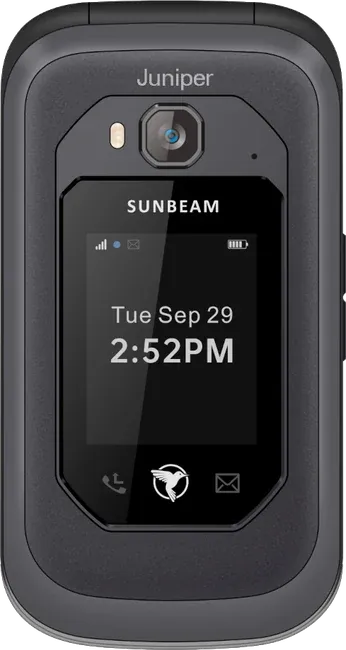
The Sunbeam F1 Pro, here in the Juniper configuration. Image: Sunbeam Wireless.
The F1 Pro comes in several configurations that share the hardware and differ in which tools are switched on. Verizon sells the Hickory at $359.99. Sunbeam’s own Cedar page, at $359.00, shows how far the strictest one goes: no “Text or Multimedia Messaging,” no “Web browser,” no “App Store.” In a review of the Juniper, the creator of the channel Your Friend Owen lists calls, “MMS, and group messaging,” visual voicemail and a hotspot, and says he was using about 20 to 25% of the battery in a full day. Sunbeam’s table marks Verizon and US Mobile Warp as working in every column.
Light Phone II and Light Phone III
Verizon lists the Light Phone II, unlocked, at $299.99. When we checked Light’s own pages on 9 November 2026, its shop showed the Light Phone II sold out, and the Light Phone III cost $899. Both are postpaid-only on Verizon, according to Light’s carrier article, and a new Verizon SIM has to be activated elsewhere before it goes into a Light Phone III. Our comparison of minimalist dumb phones covers what each Light phone does and what it costs over three years.
TCL FLIP 3
One of the few flips Verizon had in stock for prepaid when we checked, at $99.99. KaiOS, a hotspot and a web browser, as Verizon’s own listing says. A good phone for someone who wants a cheap, reliable Verizon flip. A weak one for someone whose problem is the browser.
dumbphone 2
Not a Verizon phone, and worth saying so because it tops many lists. dumb.co’s FAQ says “alternate SIM cards and phone plans are not supported on the dumbphone,” and its shop lists T-Mobile as the network. Jose Briones, in his review of the phone, tried to use it on another network: “I haven’t really been successful at it. So, you are locked to them.” At $20 plus plans from $15.99 a month it is one of the cheapest dumb phone setups in the US, but only where T-Mobile covers you.
Before you buy
- Get the IMEI first. From the phone, from the seller, or from the maker, as Sunbeam publishes one. Run it through Verizon’s checker before you pay.
- Check for HD Voice. “4G” alone is not enough on Verizon. Without HD Voice, the phone cannot make calls, including to 911.
- Decide prepaid or postpaid before you buy from Verizon. A prepaid phone activated today stays locked for 365 days of paid service. A postpaid phone bought at full retail price is unlocked at purchase.
- Check the brand, not just the network. Visible and Xfinity are on Verizon’s network and still turned Sunbeam’s phones away.
- Turn off iMessage or chat features on the old phone before you move the SIM.
- Run the group text test with two iPhones and a photo each way, inside the return window.
Which to pick
- You are on Verizon postpaid and want the least risk: a Sunbeam F1 Pro, which Verizon sells and Sunbeam marks as fully working on Verizon. Choose the configuration by how much you want switched off.
- You need a phone that survives a job site: Kyocera DuraXV Extreme+, bought at full retail price on a postpaid line so the lock is not an issue, and group texts tested in week one.
- You want the lowest monthly bill on Verizon’s network: an unlocked phone that US Mobile accepts, such as a Sunbeam, on US Mobile Warp at $210 a year. Not Visible.
- You want a Light Phone: keep a Verizon postpaid line, activate the SIM in another phone first, and expect no NumberShare.
- You just want a cheap, dependable flip and do not mind a browser: TCL FLIP 3 at $99.99. If there is any chance you will change carrier within a year, buy it at full retail price on a postpaid line, not on prepaid.
- You are not sure about dumb phones yet: do not trial one on Verizon Prepaid. Turn your current phone into one for a month with Assistive Access on the iPhone, or buy unlocked from a maker with a return policy.
The rest of the switch, from moving contacts to two-factor codes and banking, is in the complete dumb phone playbook. If you want the flip phone to keep a laptop online, which phones and plans allow it is covered in dumb phones with a hotspot.
Sources: prices and terms checked on 23 November 2026 unless noted. Verizon’s basic phones and prepaid basic phones pages, TCL FLIP 3 prepaid page, prepaid unlocking policy, device unlocking policy, device locking FAQ, BYOD FAQ, prepaid BYOD page, prepaid network update, 3G CDMA retirement notice, prepaid plans and texting troubleshooter; Apple’s iMessage deregistration page; US Mobile’s network post and plans; Visible’s compatibility page; Sunbeam Wireless’s coverage page, carrier compatibility table and F1 Pro Cedar page; Light’s carrier support article and Light Phone III introduction; Kyocera’s DuraXV Extreme+ release; dumb.co’s FAQ and shop. Checked on 26 October 2026: Charity Mobile’s Kyocera DuraXV Extreme+ listing. Checked on 9 November 2026: Light’s FAQ and Light Phone III shop page. Videos, each checked against its transcript: Jose Briones, “The Best Dumb Phones You Should Consider in 2026” and “Dumb phone 2 Review”; Shameless Nerd, “Can You Really Live in 2026 Without a Smartphone?”; Lauren Mefford, “Don’t Switch to a Dumb Phone Until You Watch This”; Your Friend Owen, “The Best Flip Phone You’ve Never Heard Of”.